
Showing posts with label Marche. Show all posts
Showing posts with label Marche. Show all posts
Wednesday, 11 December 2013

Friday, 3 May 2013
The Fresco is now a Fresci (we have two now so its Plural)

There is a gold motif with white and red roses (looks a bit like a Tudor Rose)
Adriana, our fresco expert and restorer, has done some research and has come up with some ideas of what the buildings that are depicted represent.

The Fresco dates from around 1625 and the structures in the corners represent either properties the family owned, or buildings that had a sentimental attachment to the family.
The first is the Old Medieval Tower of Gualdo that sat in the centre of the town square. Sadly, this collapsed in one of the earthquakes last century.
 |
| The Medieval Tower of Gualdo |
The second image is, we believe, the old church in Vecciola that has had a lot of remodelling over the years. Adriana thinks, that perhaps, this was the church where one of the family members worshipped and could be, the church of the wife where they were married. (What a great wedding album)
The third picture is a depiction of Cancello Est as it was many years ago with steps (no longer there) leading up to the south side of the property.
The final image is of the families hunting lodge which can still be seen at Passo St Angelo.
What a brilliant way to preserve family history for future generations.
 |
| The Old Church at Vecciola |
 |
| The Original House |
 |
| The Hunting Lodge at Passo St Angelo |
Tuesday, 30 April 2013
Tuesday, 16 April 2013
Spring Flowers Coming into their Glory


Tulips welcoming Spring ( and some fantastic warm weather in Gualdo). After such a long winter the colours really give a lift to the soul with promises of summer to come.
Spring time is one of Marches' best kept secrets!
Monday, 1 April 2013
Great day out to Ascoli Piceno


Ascoli was founded by an Italic population (Piceni) several centuries before Rome's founding on the important Via Salaria, the salt road that connected Latium with the salt production areas on the Adriatic coast. In 268 BC it became acivitas foederata, a "federated" city with nominal independence from Rome. In 91 BC, together with other cities in central Italy, it revolted against Rome, but in 89 BC was reconquered and destroyed by Pompeius Strabo. Its inhabitants acquired Roman citizenship, following the developments and the eventual fall of the Roman Empire.
 During the Middle Ages Ascoli was ravaged by the Ostrogoths and then by the Lombards of King Faroald (578). After nearly two centuries as part of the Lombard Duchy of Spoleto (593-789), Ascoli was ruled by the Franks through their vicars, but ultimately it was the bishops that gained influence and power over the city.
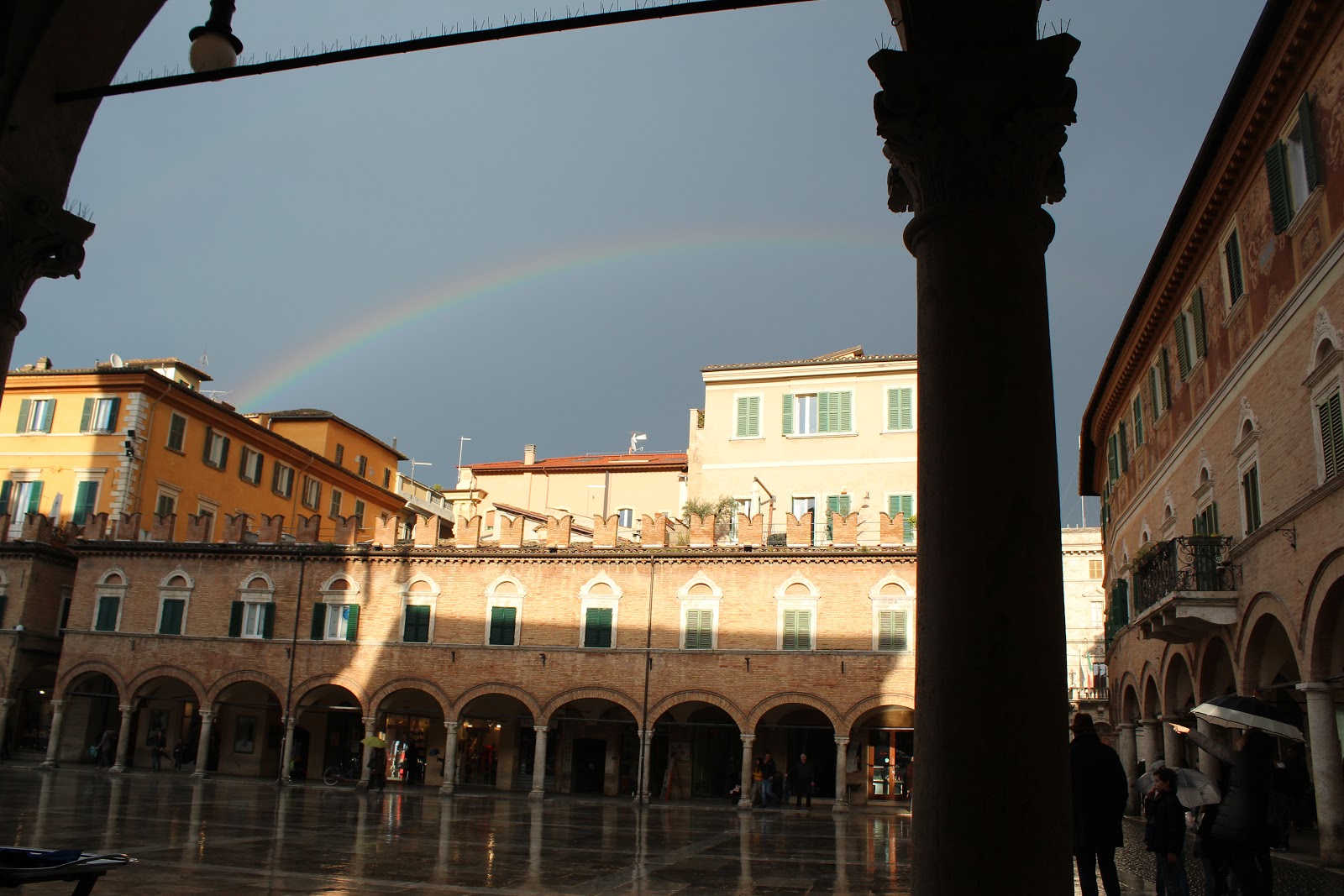 In 1189 a free republican municipality was established but internal strife led dramatically to the demise of civic values and freedom and to unfortunate ventures against neighboring enemies. This unstable situation opened the way to foreign dictatorships, like those of Galeotto I Malatesta (14th century), initially recruited as a mercenary (condottiero) in the war against Fermo, and Francesco Sforza. Sforza was ousted in 1482, but Ascoli was again compelled to submit to the Papal suzerainty. In 1860 it was annexed, together with Marche and Umbria, into the newly unified Kingdom of Italy.
The central historical part of the city is built in marble called travertino, a grey-hued stone extracted from the surrounding mountains. Its central Renaissance square, Piazza del Popolo ("Square of the People") is considered one of the most beautiful in Italy. According to traditional accounts, Ascoli Piceno was home to more than two hundred towers in the Middle Ages: today some fifty can still be seen.
Tuesday, 19 March 2013
Second Fresco Being Revealed and Looking Stunning!

In the corners so far, we have a little house with tree, a small castle and brilliant hues of blue and reds. The Two remaining corners, Adriana feels, will be two completely different images. We are getting impatient and can't wait to see more!
Now the job of researching starts so we can find out what these images represents and why they were used in the design.
The gentleman in the picture is Antonio - the brilliant builder who is restoring Cancello Est.
Monday, 18 March 2013
Monti Sibillini National Park, Italy -- National Geographic

Name: Monti Sibillini National Park
Location: Italy
Date Established: 1993
Size: 276 square miles (714 square kilometers)
Did You Know?
• Namesake Mount Sibilla is named for a legendary prophetess named Sibyl. Knights and other petitioners from across Europe made the arduous journey to her remote cave, the story goes, in hopes of gaining a few precious pearls of wisdom.
• Village Charm Eighteen charismatic towns, tucked in and among the mountains, are packed with historic art and abbeys, castles, and medieval town centers that evidence an ancient relationship between the land and its people.
• Towns Each community has its own character. Cessapalombo, meaning “cut-down forest,” dates to the third century B.C. and has a museum to charcoal burning, which was one of the early industries in the area. The valley of Acquacanina is a center of Benedictine abbeys, placed under direct Papal protection in 1192. The fortified town of Arquata is still surrounded by ancient walls and gates. And Visso, home of the park’s headquarters, is set among wooded hills where five river valleys converge in a location so inviting humans settled the spot 900 years before Rome was founded.
• Park Peaks Here in the heart of the Sibillini Mountains ten peaks soar above 6,560 feet (2,000 meters), led by Mount Vettore, which tops out at 8,123 feet (2,476 meters). The mountainous slopes that reach these dizzying heights are cut by narrow valleys and rushing rivers before giving way to pastoral alpine landscapes below the tree line.
• Plants and Animals The park is home to 1,800 plant species and a wild bouquet of mountain flowers including edelweiss, pasqueflowers, martagon lilies, bearberries, and various orchids. Animal life includes wolves and wild mountain cats as well as prickly porcupines. Roe deer have recently been reintroduced. Golden eagles, peregrine falcons, eagles, owls, goshawks, snow finches, and sparrow hawks fill the skies. And small invertebrates are among the more interesting inhabitants—several live nowhere else on Earth except in a lake here.
• Local Flavor The Sibillini Mountains have some outstanding culinary offerings. Perched between the Marches and Umbria, a smorgasbord of cured meats is always on offer. Other tasty local fare includes apples, honey, truffles, mushrooms, chestnuts, chickpeas, and vin cotto or cooked wine.
How to Get There
Trains stop in Ascoli Piceno, Spoleto, and Camerino. Bus routes also serve these towns and reach Fermo as well.
When to Visit
Winters in the mountains are cold and snowy yet beautiful, especially to cross-country skiers and other winter sport enthusiasts. And the region’s thermal springs are especially welcome at this time. Spring brings the blooming of alpine flowers, and when truly warm weather hits the entire spectrum of outdoor activities is in full swing.
How to Visit
Monti Sibillini National Park is an adventure sport center. Mountain biking, horseback riding, hang gliding, paragliding, and climbing are all popular activities here. But other visitors happily stick to town streets and enjoy the artistic, cultural, culinary, and historic traditions that have arisen and endured here over the centuries.Monti Sibillini National Park, Italy -- National Geographic
Saturday, 23 February 2013
Thursday, 21 February 2013
Uncovering Residents of Yesteryear

We think he is quite a dapper man and looks very smart in this picture.
His epitaph reads:
Husband and incomparable father who in 28 beautiful years of teaching at the elementary school placed in many precious young people seeds of knowledge and goodness.
We are going to frame this to share the history of Cancello Est with guests and hopefully find more about the families who lived here over the centuries.
Monday, 18 February 2013
Trash or Treasure and a Coincidence

More gifts from the Cantina. This plate may be rubbish, but does remind us of one of our all-time favourite movies "Tea with Mussolini". That coincidence I am sure will elevate it to treasure.
In other cities such as Florence, most or all of their towers have been brought down due to wars, catastrophes, or urban renewal, San Gimignano has managed to conserve fourteen towers of varying heights, for which it is known internationally. It is now a UNESCO Heritage site

Some of the towers are:
- Torre Grossa, (1311) 54 metres
- Torre della Rognosa, 51 metres
- Torre Cugnanesi
- Torre del Diabolo
- Torri degli Ardinghelli
- Torri dei Salvucci
- Torre Chigi, (1280)
- Torre Pettini
Saturday, 16 February 2013
Discovery in the Cantina

It looks hand painted, and is a good interpretation of the Square in Ascoli Piceno which is shown in the second picture.
The inscription says "50th Anniversary of the invalids of the war - 1917- 1967. Only 46 years old and 44 years to go before it becomes an Antique!
Ascoli is one of out favourite destination and only about 45 minutes from Cancello Est.

The central historical part of the city is built in marble called travertino, a grey-hued stone extracted from the surrounding mountains. Its central Renaissance square, Piazza del Popolo ("Square of the People") is considered one of the most beautiful in Italy. According to traditional accounts, Ascoli Piceno was home to more than two hundred towers in the Middle Ages: today some fifty can still be seen.
Thursday, 14 February 2013
The Changing Season of Gualdo
 |
| Great picture of the local church down the tree lined Avenue from the Square (thanks Carola Wicenti for the picture) |
Friday, 8 February 2013
Environmental Improvements Approved by the Mayor
 |
| Winter Wonderland from the Honeymoon Suite |
Not to be put off by the snow, we ventured on foot to the village to keep our appointment with the Mayor and the planning committee.
It turned out to be a very fruitful meeting and as they were so impressed with the improvements to Cancello Est, they listened carefully to our plans and gave us the go ahead on all our requests.
 |
| Loo with a view! |
Secondly, they gave full approval for the grey water recycling system. This will give us a good environmental solution for garden plants and our toilet systems which will all run on collected rain water (and snow!).
In addition, permission was grated for the south facing sun-deck (or sun-set deck). This will really enhance the pool area and provide a great place for guests to enjoy the magnificent views of the Sibillini National Park.
 |
| Gualdo Village Square in the Snow |
Our Archtect, Piero, thinks that we will be the only Boutique Hotel in an historic centre of Marche, that is totally environmentally self-sufficient. Lets wait and see and hope that other establishments follow suit and help us preserve this beautiful area for future generations.
 |
| Let it Snow, let it Snow, let it Snow |
Friday, 1 February 2013
Wednesday, 30 January 2013
Another Discovery at Cancello Est
 We discovered this ornate brick today - an eight-pointed star which has been carved onto the face of a totally square brick. Adriana, the Fresco expert says it dates from the 14th or 15th century and believes it was part of the original eastern gate of the village of Gualdo.
 According to christianity, the eight-pointed star is the Star of Redemption or Regeneration and represents baptism. Eight is traditionally the number of regeneration, and thus many baptismal fonts have an octagonal base.
Providing added significance is the assumption that Jesus was circumcised and named when he was eight days old (the traditional Jewish practice); baptism is seen as the New Testament equivalent of circumcision.
Finally, eight persons were saved in Noah's ark, which is another Old Testament parallel of baptism.
Well, we feel it is quite apt as there is certainly a lot of regeneration going on at Cancello Est.
If anyone can throw any more light on this we would really appreciate the feedback. We have forwarded to the local historical offices for more information.
Tuesday, 29 January 2013
It Feels like Spring has Sprung and Guest Lounge Underway

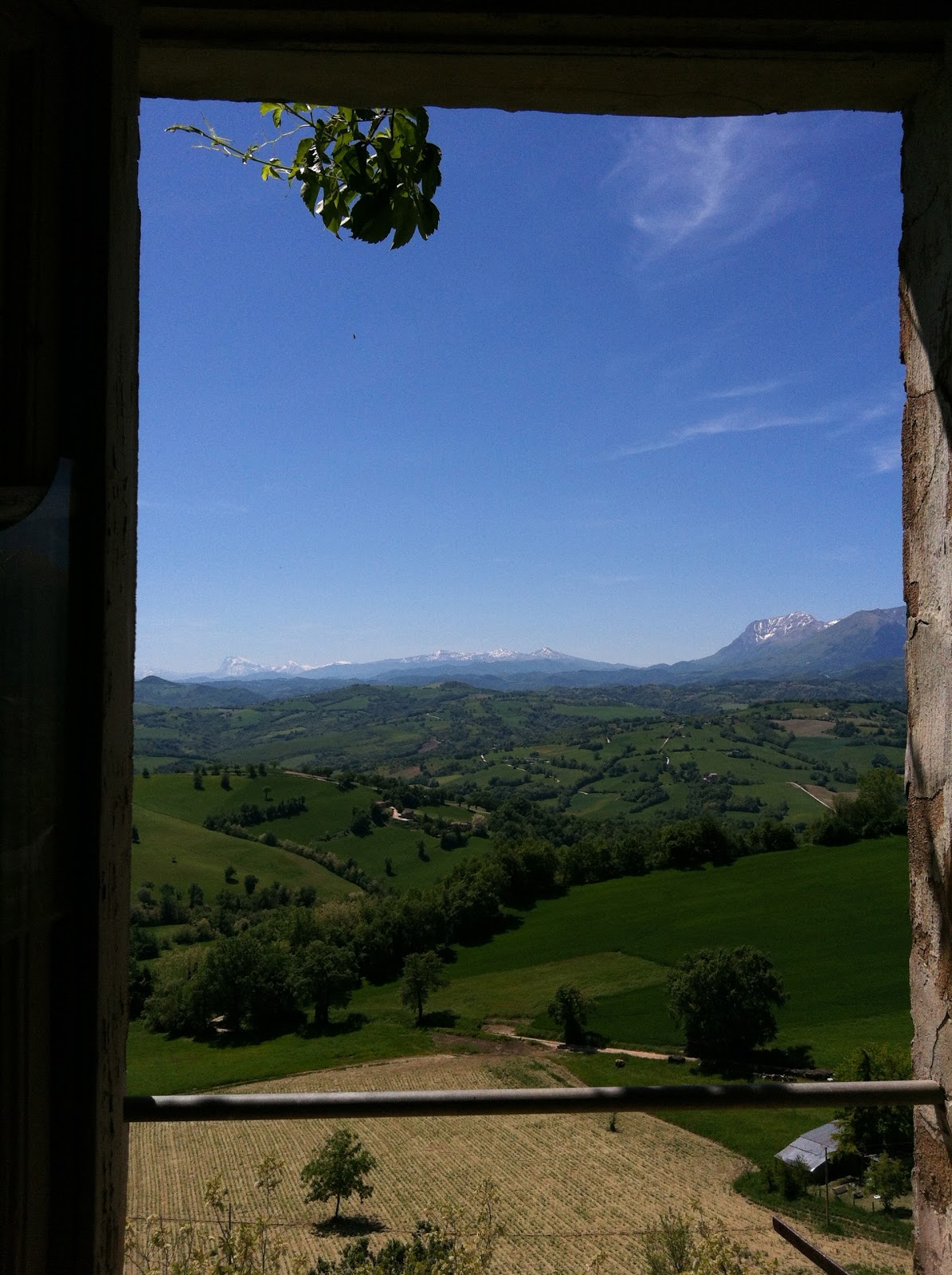
The guest lounge on 2nd floor has just had a new floor and the walls have been stripped to reveal beautiful honey coloured stone. The pictures of the views are taken from this room and are spectacular.
Beams, refurbished stone and more recycled original floor tiles will complete the look. Moving in at Easter is becoming more of a reality every day.


Thursday, 24 January 2013
Scaffolding Removal Reveals a Gem!
 |
| Before - Cancello Est is the white building bottom right with the creeper |
Before and after!
The facade has now been fully restored and what a difference it makes.
All the cement and white wash was removed by hand due to the fragility of the ancient stone.
The stonework originally was quarried by hand and you can see the craftsmanship of the 17th Century artisans.
Just need to add the windows and shutters and the old girl will look perfect.
 |
| After - Cancello Est is now the honey coloured building to the right |
Tuesday, 22 January 2013
Bridal Suite Fresco - Stage one

Wednesday, 16 January 2013
Say it with flowers - a message from the Fresci
 |
| An excerpt from the Bridal Suite Fresco - next stage is cleaning, touching up and sealing - dated to 1780 - amazing |
Thursday, 10 January 2013
Fresco Restoration Has Begun - Unbelievable Beauty Discovered

The first masterpiece will be in the bridal suite and has been dated to 17th Century.
Can you imagine waking up to this creation on the first day of your honeymoon?
Adriana, our fresco restorer has predicted that the walls will be panelled and she believes that they will have scenic views of the Marche and Sibillini views, that she says, is typical of the area and of the period. If this proves to be correct the stunning view through the window will be framed by an artist impression of the magnificent countryside.
We can' wait to see what a few more days of scraping, dissolving, restoration and good old fashioned Italian Elbow Grease will reveal - I guess as they say, watch this space!
Subscribe to:
Posts (Atom)